
Rock Removal, Boulder Splitting and Rock Services in Southern Finland
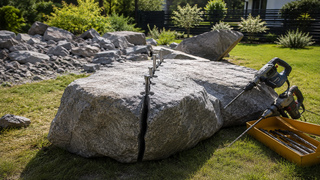
Rock removal services for gardens, properties and construction sites
Large rocks, boulders and exposed bedrock can prevent the use of a garden, block excavation work or interfere with a construction project. Fixmate provides professional rock splitting, reduction, removal and haul-away services for homeowners, housing companies, contractors and other property owners.
Depending on the site, a rock can be split into manageable pieces, lowered to ground level, relocated within the property or transported away. We specialise in hydraulic splitting and other non-explosive methods that are suitable for work close to houses, foundations, pipes, fences and other structures that require protection.
We work daily in Helsinki, Espoo, Vantaa and throughout the Helsinki metropolitan area. Services are also available across Uusimaa and, by agreement, elsewhere in Southern Finland.
Rock splitting
Rock splitting is suitable when one large rock or several boulders need to be reduced into smaller, manageable sections. The service can be used when rocks obstruct garden levelling, excavation, foundations, access routes or other construction work.
The method is selected according to the size and material of the rock, its location and the surrounding structures. Broken rock can be left on the property for reuse or transported away by agreement.
Explore the service: Rock Splitting
Boulder removal
A large boulder may occupy valuable garden space or prevent the construction of a parking area, terrace, storage building, extension or other planned structure. Moving the entire boulder may be impractical because of its weight or restricted site access.
In these situations, the boulder can be split in a controlled way into smaller sections. The pieces can be relocated, reused for landscaping or transported away.
Explore the service: Boulder Removal
Garden rock removal
A rock located in a garden can interfere with lawn installation, paving, planting areas, fences, pathways or outdoor living spaces. Garden rock removal can involve removing the complete rock or reducing the exposed section to the required level.
The working method is selected according to the size of the garden, site access and the location of the rock. Many jobs can also be completed in restricted-access areas where large machinery cannot enter.
Explore the service: Garden Rock Removal
Hydraulic rock splitting
Hydraulic rock splitting is a controlled method for breaking large rocks and bedrock. Holes are drilled into the material and hydraulic wedges are inserted. Increasing pressure creates a fracture along the planned line without using explosives.
The method is particularly suitable near houses, foundations, pipes, utility lines, fences and other sensitive structures. The rock can be reduced gradually while taking the surrounding area into careful consideration.
Explore the service: Hydraulic Rock Splitting
Non-explosive rock excavation
Non-explosive rock excavation is used when rock or a larger rock mass cannot or should not be removed by blasting. The work can be completed through drilling, hydraulic splitting and other controlled methods.
This approach is suitable for residential areas, compact properties, locations close to buildings and projects where vibration, pressure waves and extensive protective measures should be reduced.
Explore the service: Non-Explosive Rock Excavation
Bedrock removal and breaking
Exposed bedrock can prevent the construction of foundations, driveways, parking spaces, terraces, retaining walls, utility trenches and other structures. During bedrock removal, only the section required for the project is treated and reduced into removable pieces.
The scope may range from lowering a small rock outcrop to gradually breaking a larger area. The final method, equipment and haul-away solution are always planned according to the site.
Explore the service: Bedrock Removal and Breaking
A controlled alternative to unnecessary blasting
Not every rock removal project requires blasting. Hydraulic splitting and other controlled methods are often suitable when work is completed close to buildings or in compact, difficult-to-access areas.
The advantages of non-explosive methods include greater control, reduced vibration and the ability to reduce the rock in stages. Drilling produces normal construction noise, but the splitting process does not create the sudden pressure wave associated with blasting.
Request an estimate for rock removal
Send photos of the rock or bedrock, approximate dimensions, the site address and a short description of what you plan to build in the area via WhatsApp. Include information about access and whether you want the broken material left on the property or transported away.
Based on the photos and site details, we can often assess the appropriate working method, required equipment and preliminary scope of the job.
